1900
Library attendance is 53,000 this year, with 26,000 books given out. Miss S. E. Taylor dies, leaving $2,000 to the library.
1901
John B. Jenkins and Barton Myers apply to Andrew Carnegie for a grant to build a new library and receive the promise of $50,000 on the condition that the city appropriate $5,000 for maintenance. The children of William Selden give land on Freemason Street as a site for the new library and as a memorial to their father.
At his death, H. D. Van Wyck bequeaths $15,000 to the library for the purchase of a lot for a library branch.
1902
There are three collections of books available to the Norfolk Public this year: the Norfolk Public Library collection (about 8,000 volumes); the YMCA library; and the Norfolk and Portsmouth Bar Association Law Library. A charter from the legislature gives city councils in Virginia the authority to appropriate up to $5,000 a year for support and maintenance of libraries.
October 8, 1903
The cornerstone for the Carnegie Library on Freemason Street is laid under Masonic auspices by Owens Lodge. Herbert D. Hale of Boston drew the plans for the building.
November 21, 1904
Norfolk's first free public library opens quietly on West Freemason Street, with no special ceremonies to mark the occasion. John L. Roper is the new president.
1904
The new library has 2,712 members; 11,403 books; and a circulation of 34,225.
1905
Anna Cogswell Wood's Irene Leach Memorial art collection is housed on loan at the Freemason Street library. Its care is taken over by the Leache-Wood Alumnae Association at this time.
October 1, 1905
E.W. James, a director of the library and editor of the Lower Norfolk County Antiquary, dies, leaving his collection of books and $1,000 to the library. Mr. Carrington Grigsby and his sister, Mrs. W. W. Galt, give the Grigsby collection of old Norfolk newspapers to the library’s Virginiana collection.
1916
The Library Board votes to use the Van Wyck bequest (see 1901) to build a branch opposite Maury High School. An application is made to Andrew Carnegie, who gives the city a grant of $20,000 under the same conditions as his earlier grant (1901). Norfolk architects Ferguson, Calrow and Wren draw the plans for the branch.
May 15, 1916
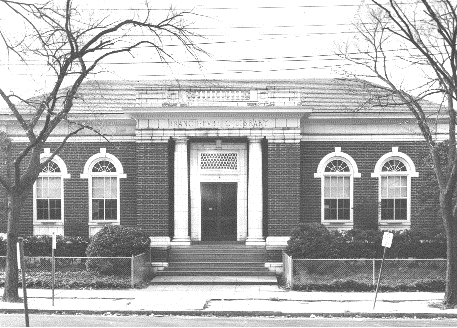
Van Wyck Branch, Norfolk's first branch library opens at 345 Shirley Avenue.
1917
Mr. Sargeant dies on March 23. In May, Miss Mary Denson Pretlow becomes librarian. All non-fiction books (around 14,000) are reclassified to conform to the Dewey Decimal System. The reclassification is completed in 1938.
World War I
The library opens on Sunday afternoons during the War until August 1920. Local people donate books and magazines to be sent to servicemen, and library staff, with the assistance of enlisted men stationed here, pack them for delivery.
June 24, 1918
Capt. Roper dies. Robert M. Hughes becomes President of the library board.
September 1918:
- Miss Pretlow goes overseas in September 1918 to work with the YMCA on American military bases. Janet Carter Berkley serves as acting librarian for a year.
- During World War I, the library acts as an agent for selling War Stamps.
- The library is closed for four weeks during the influenza epidemic of October 1918.
- During part of 1919 and all of 1920, the library furnishes books to the Merchant Marine and the Public Health Hospital.
April 20, 1921
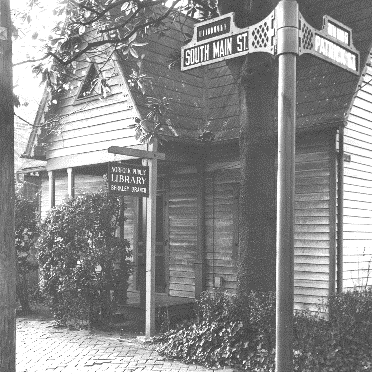
The Berkley Branch opens at 517 Main Street (later S. Main). It later becomes the Horace C. Downing Branch.
July 19, 1921
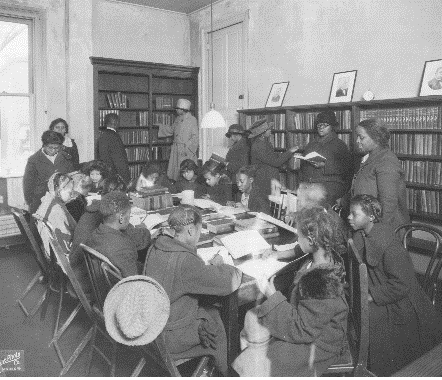
The Blyden Branch opens. It is the first library for African Americans supported by a municipality in Virginia.
April 26, 1922
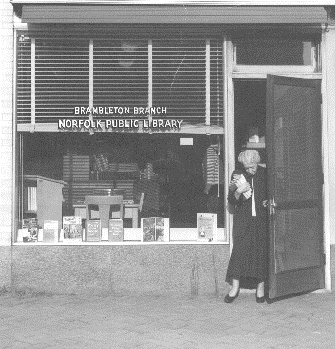
The Brambleton Branch opens at 1520 E. Brambleton Ave.
July 21, 1923
The Ocean View Branch (later Pretlow) opens on the second floor of an office building. In 1939, it moves into a large room in Ocean View School with a separate entrance on Government Ave. It moves to its present location in 1961.
September 24, 1923
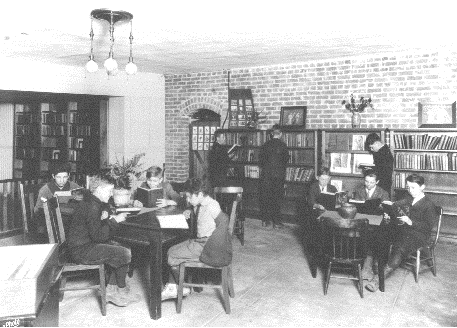
The Tanners Creek Branch opens in a half-basement in Larchmont School. It will later become the Larchmont Branch.
1924-25
Government Documents on deposit are cataloged.
1925
The library has 52,000 members, and attendance is 241,000. Norfolk ranks 38th among 43 cities with a population of 100,000 to 200,000 in per capita budget for libraries.
1926
The Norfolk City manager designates $35,000 for the library's budget.
May 1927
The opening of the Sargeant Memorial Room, with Mary Churchill Brown in charge. Due to the efforts of Mr. Sargeant and Miss Pretlow, there is finally enough Virginiana to set aside an entire room – the former Library Board room – for the collection. The collection includes one of the most complete files of historical newspapers in the U.S at that time. By 1957, SMR averages six patrons a day.
1921-1920
The greatest period of growth because of the opening of many branches.
July 1, 1930
Opening of the Lafayette Branch in a storefront at 3126 Cottage Toll Road (now Tidewater Drive).
1932
This is the greatest year of activity thus far (other than wartime), with circulation at 1/2 million.
January 13, 1933
The library is opened on Sunday afternoons from 2:30 to 6 p.m. as an experiment of indefinite duration. (This practice was begun during World War I, but attendance dropped so sharply that the Sunday schedule had been abandoned after Armistice Day.)
1934
With the population of Norfolk 129,710, the library boasts 50,972 members; 80,833 books; and a circulation of 385,747.
A "pay collection," begun during the Depression, lasts until 1944. Books are purchased from the fines account and placed in the pay collection. They are loaned for 10¢ per circulation until paid for, then put on the regular shelf.
1937
Military Hospital Service is inaugurated by NPL, when the Junior League begins this service at Norfolk General Hospital. The Women's Auxiliary at St. Vincent's begins service there in 1942.
1940
A study of the main library made by Brigham and Hughes terms the building a "formidable staircase surrounded by inadequacies and inconveniences," and says that "the side of Norfolk's cultural development which was most often neglected was represented by its public library." The main building is too small; the seven branches are overcrowded and understaffed. Norfolk does not act on this report for more than ten years.
1943
The Library Board votes to convey all library properties to the City of Norfolk and to turn over the operation of the library system to the City. By ordinance effective 25 November, the library ceases to be operated as a private corporation.
1946
Land on Olney Road is chosen as a potential site for a new central library.
January 1947
A "branch" is created at the South Pole, when 12 books from the Norfolk Public Library are loaned to Admiral Byrd's expedition.
April 1947
John A. Norton comes to NPL as Director.
1950-1952
The number of books loaned declines (298,000 in 1952; daily attendance 500).
October 1951
John A. Norton resigns as Library Director.
July 1, 1952
Arthur M. Kirkby from Enoch Pratt Free Library in Baltimore succeeds J. A. Norton as Librarian.
1952-56
The number of books loaned increases 60% after City Council increases the book budget 2.5 times. The number of reference questions triples.
July 1, 1953
The Board engages Alfred Morton Githens, the foremost library architect in the country, as consultant for building a new library.
September 1954
A move is made to combine the Norfolk Public Library and the Norfolk Division, College of William and Mary library. The Board issues a statement pointing out the impracticability of such a move.
September 1954
A proposal is made to move the Berkley Branch to the Berkley police precinct station, since the old library building is inadequate. A $15,000 appropriation from City Council is requested. Council delays action on the request, ordering instead a study of the cost to rebuild.
August 29, 1955
Berkley Branch reopens in a new building at 225 E. Berkley Ave.
July 17, 1956
The City of Norfolk launches its first Bookmobile to provide service to the 55,000 residents of the recently annexed Tanner's Creek area of Norfolk County.
1956
The Friends of the Norfolk Public Library form to raise support for building a new central library.
1957
Blyden Branch opens at 879 E. Princess Anne Road.
March 1957
The Friends of the Norfolk Public Library organize with 2,400 members. Their first annual meeting is held on 29 May. Dues are 50¢ per year.
1957
Harold G. Sugg suggests a new study of the prospective library site. Norfolk's population has doubled and two annexations have taken place since the Olney Road site was selected in 1946. The 42-room Joynes mansion, close to City Park, is recommended by several people as ideal for the new library.
1958
Norfolk City Council calls for a full study of the main library site.
1958
Russell Munn and Keith Doms are hired by City Council to study the library and recommend specifications for a new main library building. They say "with respect to library service, Norfolk is one of the most under-privileged cities in the U.S. ... Based on per capita figures of books owned, books loaned and dollars spent, Norfolk has about 1/3 of a library system, compared with other cities in its population group.
1958
$100,000 is pledged from the Munro Black fund of the Norfolk Foundation for the new building, stipulating that it must be begun within three years and must cost more than $1,500,000.
In a comparison with 24 cities in the 250,000 - 500,000 population group, Norfolk ranks at the bottom with .44 books per capita, 1.77 books loaned per capita and an expenditure of 68¢ per capita.
Munn and Doms recommend the relocation of Lafayette, Larchmont and Ocean View branches; new branches to be located at Wards Corner, Five Points, the Military Highway/Little Creek Road intersection; the purchase of one additional bookmobile; the closing of the Brambleton Branch; a $2,000,000 central library; and a greatly increased operating budget.
August 8, 1960
A second Bookmobile hits the streets to serve residents of the portion of Princess Anne County (Kempsville District) recently annexed to the City of Norfolk.
1961
Pretlow Branch opens at 9640 Granby Street, replacing the former Ocean View Branch.
1962
Kirn Memorial Library, the new central library for the City of Norfolk, opens at 301 E. City Hall Ave.
1966
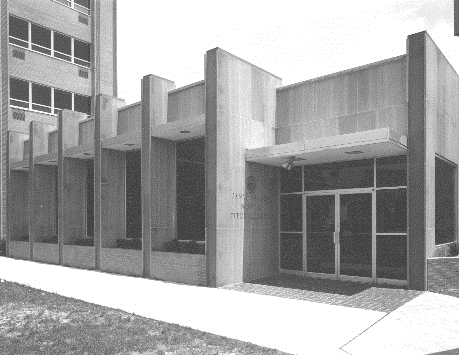
Janaf Branch opens at 124 Janaf Shopping Center,
1967
Little Creek Branch opens at the intersection of Little Creek Road and Tarpon Place.
1968
The Tanner's Creek Branch, renamed Larchmont Branch after the neighborhood, moves to its present location at 6525 Hampton Blvd.
1970
Lafayette Branch moves to its present location at 1610 Cromwell Road.
1972
A dine arts, music & video collection, the Feldman Audio-Visual Dept. opens at Kirn.
1977
Dean C. Gross hired as Director of the Norfolk Public Library system.
1977
Barron F. Black Branch opens at 6700 E. Tanners Creek Drive.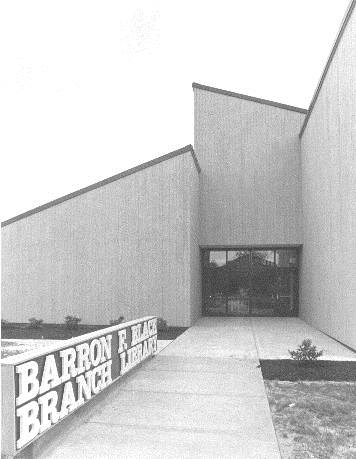 1979
1979
Park Place Multi Service Center (formerly the Black Culture Center, established in 1970) opens at 606 w. 29th Street.
1983
Sue E. Darden becomes Library Director.
1986
A new Brambleton Branch is dedicated at 961 Park Avenue.
1989
Norfolk Public Library begins the process of automation, sending its shelf list to OCLC for conversion.
1989
Kirn Library is closed during June-September for asbestos abatement. Limited telephone reference service is provided by Kirn staff from the cafeteria of Blair Middle School on Colley Avenue.
1991
The first module of the library’s automated public access catalog comes up, when the cataloging module is put into place. Other modules, including dial-in access, quickly follow.
1995
NPL goes global when, through a joint project with WHRO public television, the library creates its own Home Page with Internet access and begins to offer public access to the Internet through terminals at Kirn and selected branches.
1995
Reference departments at Kirn Library merge and a one-point reference/circulation service desk is created.
1995
Sally G. Reed is hired as Norfolk Public Library Director.
1997
The Brambleton Branch Library is renamed Jordan-Newby Branch in honor of the late Judge Joseph A. Jordan and members of the Newby family.
1999
New state-of-the-art Bookmobile is put into operation.
1999
On 13 June, the Berkley Branch is renamed the Horace C. Downing Branch, in honor of the late civic leader, fondly known as the “Mayor of Berkley.” A computer, funded with a grant from the Bill and Melinda Gates Foundation, is dedicated at the same time. Downing dies at the age of 82 in April 1999.